NR-010Ingredient Atlas entry · Herb

Chamomile

Matricaria chamomilla (German chamomile) and Chamaemelum nobile (Roman chamomile), from the daisy family

A rabbit's dose of tea, a Saxon charm, a flower that thrives on being trodden on and a perfumer's blue oil. People have drunk chamomile, walked on it and argued over it for two thousand years. The ancient doctor who said Egypt gave it to the sun also said Egypt was wrong.

  • Part used: flower
  • Tested as tea, capsules, oils, gels and mouthwash
  • Mostly 12 weeks or less
Dried chamomile flowers beside a glass teapot of chamomile tea
Dried chamomile flowers beside a glass teapot of chamomile tea. Photo by Irene Ivantsova on Unsplash

A dose of camomile tea

Dunkeld, Scotland, 4 September 1893. Beatrix Potter cannot think what to write.1

She is twenty-seven and on holiday, and the letter is for Noel Moore, the five-year-old son of her former governess. Noel is getting over an illness. "I don't know what to write to you," she begins, "so I shall tell you a story about four little rabbits."1

Old Mrs Bunny tells her children they may go into the field or down the lane, "but don't go into Mr McGregor's garden". Flopsy, Mopsy and Cottontail are good little rabbits, and they go down the lane to gather blackberries. Peter is very naughty.1

By page seven Mr McGregor has hung up Peter's little jacket and shoes as a scarecrow, to frighten the blackbirds. "Peter was ill during the evening, in consequence of over eating himself. His mother put him to bed and gave him a dose of camomile tea." The three good rabbits have bread and milk and blackberries for supper.1

Publishers turned the story down, so in December 1901 Potter printed 200 copies of The Tale of Peter Rabbit herself. Then Frederick Warne took it on, and by the end of 1902 the firm had printed 28,000. On the way the tale grew darker. Peter's father, the book now said, "had an accident there; he was put in a pie by Mrs. McGregor." The camomile tea stayed.1, 2

Long before Peter's dose, chamomile had been a garland, a cure, a charm, a joke and a crop. Its name began with an apple.

An apple on the ground

The Greeks called it chamaimelon, the earth-apple. In the first century AD Dioscorides wrote a Greek book of medicines that shaped Europe's herbal medicine. The plant earned its name, he says, because it smells like apples.3, 4, 5

He knew three kinds, with round heads and golden middles, ringed with petals that were white, yellow or purple. They grew in rough places and beside the roads. The Roman writer Pliny adds that people picked it in spring to make garlands.4, 6

A century later Galen, doctor to the emperor Marcus Aurelius, likened it to the rose, only warmer. In his pages it eased pain, loosened what was tight and softened what was hard, and for weariness it was as good as anything.7, 8

He also passed on what the wisest men of Egypt believed about it, and said plainly that they were wrong.

Have in mind, thou maythen

In England the earth-apple had a name of its own. An Old English herbal calls it maythe, and for sore eyes it tells you to pick it before the sun comes up.9, 10

In a book of cures copied early in the eleventh century, a healer sings to nine herbs. Mugwort is told to remember. Waybroad, which grows by the wayside, is praised because carts creaked over it, queens rode over it, brides and bulls went over it, and it withstood them all. Later the song turns to maythen.11, 12

"Have in mind, thou maythen," it goes, "what thou accomplishedst at Alderford," so that no man ever died of a "flying ill" once maythen went into his medicine. What happened at Alderford, the charm never says. Oswald Cockayne, the Victorian clergyman who translated it, could only call the allusion dark and point to a place of that name in Norfolk. He took the flying ill for an infection, a disease "flying from one to another".12

In the same song the god Woden takes up nine wondrous twigs and strikes a serpent until it flies into nine bits. A few lines later the Lord in heaven forms the herbs. The healer sang the charm three times over each herb before working them up. Then he sang it into the sick man's mouth, into both his ears and into the wound, before the salve went on.12, 13

The more it is trodden

In 1551 the English doctor William Turner found chamomile scarce in Germany. In England it was so plentiful, he wrote in his New Herball, that it grew wild on Richmond Green and Brentford Green, "and in mooste plenty of al, in hunsley hethe."14

Tread on it and it only spreads, or so the Elizabethans said. In 1579 a young writer, John Lyly, leapt into fame with a novel called Euphues, written in a style built on balanced comparisons. One of them ran, "though the Camomill the more it is troden and pressed downe, the more it spreadeth, yet the Violet the oftner it is handeled and touched, the sooner it withereth and decayeth."15, 16

Shakespeare took the line and made it a joke. In Henry IV, Part 1, printed in 1598, Falstaff plays the King in a tavern in Eastcheap, with a cushion for his crown. Prince Hal plays himself. "For though the camomile, the more it is trodden on, the faster it grows," Falstaff tells the prince, "so youth, the more it is wasted, the sooner it wears." The Hostess calls it "excellent sport".17, 18

Three centuries later a scholar judged that Shakespeare had caught Lyly's style perfectly, and "accurately caricatured its vapid artificiality".16

In 1652 Nicholas Culpeper, "Student in Physick and Astrologie", promised readers they could cure themselves for three pence, with herbs that grow in England. He found chamomile so well known "that it is but lost time and labor to describe it". He vouched for one wonder he had seen tried. A stone taken out of a man's body, wrapped in chamomile, would dissolve, "and in a little time too".19

A blue oil from Mitcham

By the 1860s chamomile was a London crop. At Mitcham, near the city, about 55 acres grew it in 1864. The flowers were carefully gathered and dried by artificial heat. They sold for about £9 a hundredweight, when foreign chamomile fetched £3 or £4.20

The crop went by a foreign name, Roman chamomile, though the plant grew wild on the commons around London. The name was already old. German apothecaries used it in Turner's day, and in 1598 Joachim Camerarius linked it to Rome, where he had seen the plant growing in plenty.14, 20

Distilled, chamomile gives an oil that is pale blue at first and turns brown within months. In 1863 Septimus Piesse, author of The Art of Perfumery, went after the colour. He distilled the blue oil over and over until it was pure, and found that even its vapour was blue.20, 21, 22

"I have named this substance Azulene," he told the Chemical Society, "from azure, blue." He found it in wormwood, patchouli and bergamot as well. Less than one per cent of it was enough to turn chamomile's famous oil blue.21, 22

The flower in the maze

In 1995 a team in Buenos Aires took apart a water extract of the flowers. They found apigenin, a compound that clung to the same brain receptor as the benzodiazepine drugs. It made mice less anxious on a raised maze.23

In 2009 a team in Philadelphia ran what it called the first controlled clinical trial of chamomile extract for generalised anxiety disorder, with 57 patients over eight weeks. What it found is in the Research tab, with the trials that followed.24, 25

The sun god's flower

An encyclopedia of alternative medicine gives Egypt one line in its chamomile entry. The Egyptians "valued the herb as a cure for malaria" and dedicated it "to their sun god, Ra." The entry names no source for either.26

Go back to 1931 and A Modern Herbal by Mrs M. Grieve. Her Egyptians dedicated chamomile "to their gods", because they believed it cured ague, an old word for fever. Later in the entry she quoted William Turner, splicing in his lines about a different flower. Her quotation stops at the Egyptians' "only remedy of all agues".27

Turner's next sentence is missing. In 1551 he had written that the wise men of Egypt consecrated chamomile "vnto the sonne" and reckoned it the only remedy of all agues. "But in that they were deceyued," he went on, because it healed only some fevers.14

Culpeper told the story in 1652, and he named a source. "Nichessor saith the Egyptians dedicated it to the Sun becaus it cured Agues; and they were like enough to do it, for they were the arrantest Apes in their Religion that ever I red of."19

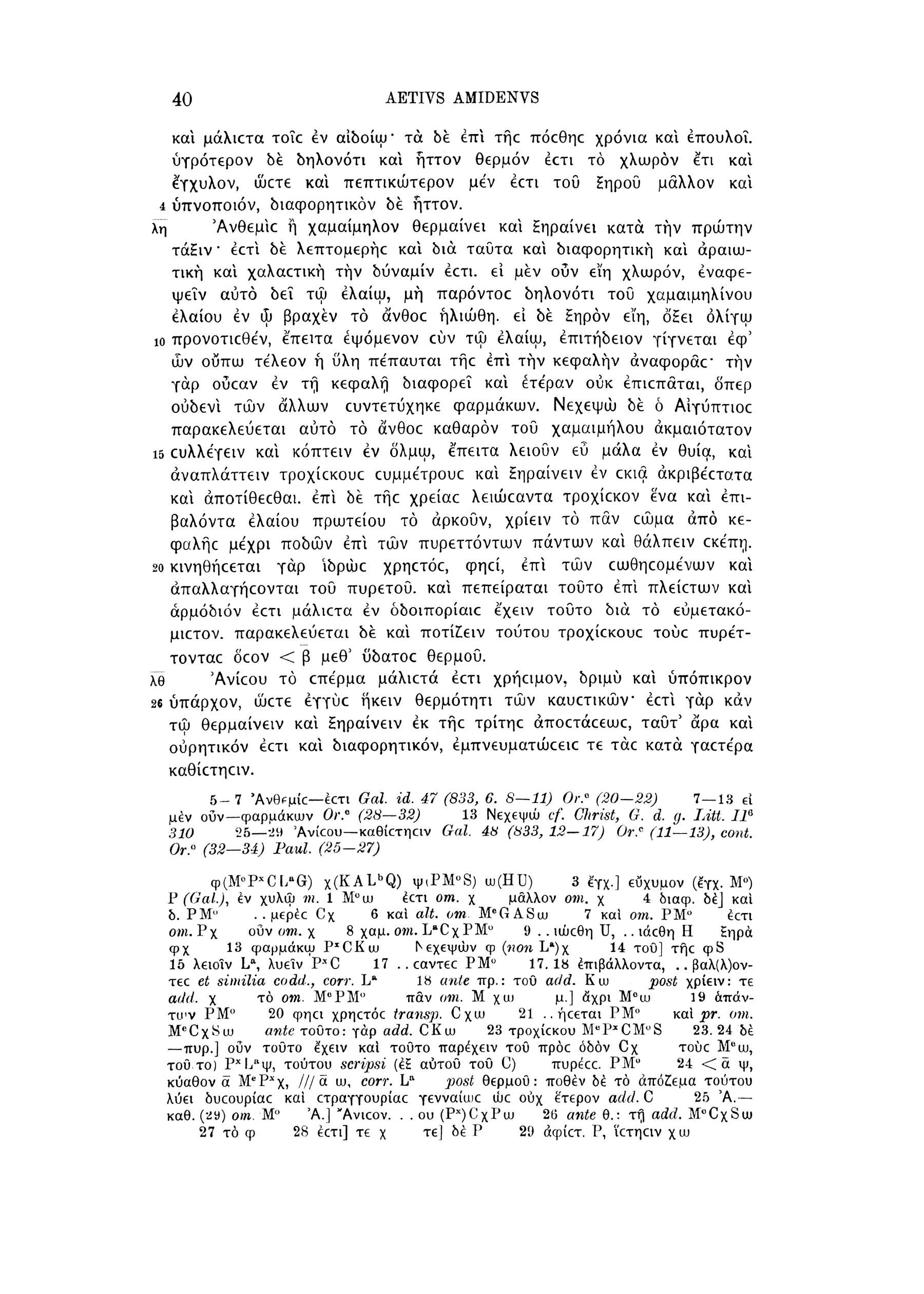
Nichessor is Nechepso, a pharaoh half history and half legend, whose name was put on a much-quoted astrology book of about 150 BC. In the sixth century the Byzantine doctor Aetius did quote "Nechepso the Egyptian" on chamomile. But Nechepso gave a recipe. Gather the flowers at their peak, make them into lozenges and dry them in the shade. For any fever, grind one into oil and rub it over the patient from head to foot. Those who were going to live would break into a good sweat. Nothing about the sun.28, 29, 30

The sun comes from Galen, whom Turner had followed line by line. In the second century AD Galen wrote that because chamomile cured fevers, the wisest of the Egyptians had dedicated it to the sun and thought it cured every fever. "But in this," he added, "they are not telling the truth." Galen named no wise man, no temple and no book. There the trail ends.7, 8, 14

Eighteen centuries later, the sun god has a name and the fevers have become malaria. The one sentence that kept the story honest, Galen's own, fell out on the way.

Fields of Egypt

Egypt grows chamomile now. From March to the end of April women and girls do much of the picking, by hand. A photographer who followed them in 2022 called the pay low for such hard work.31

Today chamomile is studied as a tea or capsule, as an oil or gel on the skin, as a mouthwash and as a scent. What the trials found is in the Research tab.25

The Greeks smelled apples in it, the Saxons sang to it, and Falstaff trod it down for a laugh. Peter Rabbit got the tea.
See what modern trials found

Myths and facts

In the record, or legend?

Every story you will read about this plant, checked against the oldest source we could find.

  • The Egyptians dedicated chamomile to their sun god, Ra

    Told, not shown

    Galen, in the second century AD, says Egypt's wisest men dedicated it to the sun. He names no one and no text, and we found no older source. The name Ra first appears in the trail in an encyclopedia of alternative medicine, which gives no source7, 26

  • The Egyptians used chamomile to cure malaria

    Told, not shown

    Galen says they thought it cured every fever, and that they were wrong. "Malaria" is a modern swap for the old "ague" and "fevers"7, 14, 26, 27

  • The name chamomile means "ground apple"

    In the record

    Greek chamaimelon, earth-apple. Dioscorides and Pliny say it was named for its apple smell3, 4, 6

  • People have used chamomile for thousands of years

    Partly

    Dioscorides and Pliny describe chamaimelon about two thousand years ago. In 1879 two Victorian pharmacologists judged that identifying the plant in ancient authors "seems to be impossible", because so many relatives have similar flowers4, 6, 20

  • Chamomile was one of the Saxons' nine sacred herbs

    Likely

    The Nine Herbs Charm, copied early in the eleventh century, calls on maythen. An Old English herbal uses that name for the Greek chamaimelon, but it also covered mayweed. Cockayne's glossary leaves the charm's maythen unassigned, so reading it as chamomile is ours. The charm never calls its herbs sacred, and the "nine sacred herbs" wording appears in the same encyclopedia as the Ra story9, 10, 11, 12, 26

  • "The more it is trodden, the faster it grows" is Shakespeare's line

    Partly

    Falstaff says it in Henry IV, Part 1, printed in 1598, as a parody of John Lyly's Euphues of 157915, 16, 17, 18

  • Peter Rabbit was given chamomile tea

    In the record

    In Beatrix Potter's 1893 letter and in the 1902 book1, 2

  • Roman chamomile is named after Rome

    Partly

    The name does mean Roman, and German apothecaries already used it in 1551, William Turner says. In 1598 Joachim Camerarius linked it to the plant growing in plenty near Rome, but who first called it Roman, and why, is not shown14, 20

In the record means a source from the time, or a scholar quoting one, says it. Likely means a named expert's reasoned identification. Told, not shown means one interested party says it and nothing checks it. Partly means a real event sits under a bigger story. Legend means the earliest source is far too late or missing. Wrong date means the event is real but the popular date doesn't match the record.

Notes

Every fact in the story points to one of these. Where a translation is ours, the note says so.

Show all 31 notes Hide the notes
  1. Victoria and Albert Museum, "Peter Rabbit picture letter" (illustrated letter to Noel Moore), LOAN:PEARSON PLC.1:2-1991, https://collections.vam.ac.uk/item/O1513976/ (record read through the museum's API, https://api.vam.ac.uk/v2/object/O1513976). The museum's transcription of pages 1, 2, 7 and 8: "Eastwood, Dunkeld, Sep 4th 93 / My Dear Noel, I don't know what to write to you, so I shall tell you a story about four little rabbits"; "'Now my dears', said Old Mrs Bunny 'you may go into the field or down the lane, but don't go into Mr McGregor's garden'. Flopsy, Mopsy and Cottontail, who were good little rabbits went down the lane to gather blackberries, but Peter, who was very naughty"; page seven, "Mr McGregor hung up the little jacket + shoes for a scarecrow, to frighten the blackbirds. Peter was ill during the evening, in consequence of over eating himself. His mother put him to bed and gave him a dose of camomile tea."; page eight, "but Flopsy, Mopsy and Cottontail had bread and milk and blackberries for supper." The museum's description: Potter "was twenty-seven years old"; Noel was "the five year old son of Beatrix's former governess Annie Moore (née Carter)" and "was recovering from an illness"; the letter was sent "whilst on holiday in Dunkeld"; "the manuscript was rejected by publishers so Beatrix privately printed the book in an edition of 200 copies ... in December 1901"; Warne published it "in October 1902 in an edition of 8000 copies; by the end of the year a further 20,000 copies had been printed"; she added "details such as the famous rabbit pie". The museum shows no images of the letter online, so the quotations follow its transcription. ↩
  2. Beatrix Potter, The Tale of Peter Rabbit (London: Frederick Warne, 1902), Project Gutenberg eBook 14838, https://www.gutenberg.org/ebooks/14838 : Mrs Rabbit warns that "your Father had an accident there; he was put in a pie by Mrs. McGregor"; and "His mother put him to bed, and made some camomile tea; and she gave a dose of it to Peter!" ↩
  3. H. G. Liddell, R. Scott and H. S. Jones, A Greek-English Lexicon, "χαμαίμηλον": "earth-apple, camomile, chamomile" (citing the Orphic Argonautica, line 921); as a second sense it equates the word with white anthemis, citing Dioscorides 3.137 and Pliny 22.53, https://lsj.gr/wiki/χαμαίμηλον ↩
  4. Dioscorides, De materia medica III.137, in M. Wellmann (ed.), Pedanii Dioscuridis Anazarbei De materia medica, vol. 2 (Berlin: Weidmann, 1906), pp. 145-146 (read off the page images), https://archive.org/details/BIUSante_65865x02 . Translation ours: "ἀνθεμίς· οἱ δὲ λευκάνθεμον, οἱ δὲ ἠράνθεμον, ἐπεὶ ἔαρος ἀνθεῖ, οἱ δὲ χαμαίμηλον διὰ τὴν πρὸς τὰ μῆλα ὁμοιότητα τῆς ὀσμῆς" (anthemis; some call it leukanthemon, some eranthemon because it flowers in spring, some chamaimelon because its smell is like apples); "ταύτης εἴδη τρία, ἄνθεσι μόνον διαφέροντα" (there are three kinds, differing only in their flowers); "κεφάλια περιφερῆ, ἔνδοθεν μὲν λευκὸν καὶ χρυσίζον ἀνθύλλιον ἔχοντα, ἔξωθεν δὲ περίκειται κυκλοτερῶς λευκὰ ἢ μήλινα ἢ πορφυρᾶ ⟨φυλλάρια⟩" (round heads with a white and golden floret in the middle, and around the outside, in a ring, white or yellow or purple petals); "φύεται δὲ ἐν τόποις τραχέσι καὶ παρὰ τὰς ὁδούς, συλλέγεται δὲ ἔαρος" (it grows in rough places and beside roads, and is gathered in spring). Which of today's species he meant is not certain (note 20). ↩
  5. P. O. Staub, L. Casu and M. Leonti, "Back to the roots: A quantitative survey of herbal drugs in Dioscorides' De Materia Medica (ex Matthioli, 1568)", Phytomedicine 23 (2016): 1043-1052, abstract, https://pubmed.ncbi.nlm.nih.gov/27444350/ : "De Materia Medica written by Pedanios Dioscorides (1 century CE) has shaped European and Mediterranean herbal medicine to a large extent". ↩
  6. Pliny the Elder, Natural History XXII.26 in the Bostock and Riley numbering (XXII.53-54 in modern editions), J. Bostock and H. T. Riley (trans.), The Natural History of Pliny (London, 1855), Perseus, http://www.perseus.tufts.edu/hopper/text?doc=Perseus:text:1999.02.0137:book=22:chapter=26 : others call it "'chamæmelon,' because it has a smell like that of an apple"; "This plant is mostly found in thin, poor soils, or growing near foot-paths. It is usually gathered in spring, and put by for the purpose of making chaplets." The Latin (Mayhoff) has "chamaemelon, quoniam odorem mali habeat" and "in macro solo aut iuxta semitas". Perseus may ask a browser to allow cookies. ↩
  7. Galen, De simplicium medicamentorum temperamentis ac facultatibus III.10, in C. G. Kühn (ed.), Claudii Galeni Opera Omnia, vol. 11 (Leipzig, 1826), p. 562, Greek with Latin (read off the page image), https://archive.org/details/b29339339_0011 . Translation ours from the Greek, checked against Kühn's Latin. Chamaimelon is like the rose in fineness of parts but nearer to oil in warmth; for weariness it helps as well as anything (Latin "lassitudini ut si quid aliud cum primis confert"); it soothes pains, relaxes what is tense and softens what is moderately hard; it dissolves fevers that come without inflammation of an inner organ, especially those from bilious humours or dense skin. "ταύτῃ τοι καὶ τῶν Αἰγυπτίων τοῖς σοφωτάτοις ἡλίῳ τε καθιέρωται καὶ πυρετῶν ἁπάντων ἴαμα νενόμισται. ἀλλὰ ἐν τούτῳ μὲν οὐκ ἀληθεύουσιν. μόνον γὰρ ὧν εἴρηκα πυρετῶν ἔστιν ἴαμα καὶ τούτων ἤδη πεττομένων" (for this reason the wisest of the Egyptians dedicated it to the sun and held it a cure for all fevers. But in this they are not telling the truth, for it cures only the fevers I have named, and those only once they are ripening). Kühn's Latin: "ab Aegyptiorum sapientissimis soli consecratum est, febriumque omnium putatur remedium. Verum hac quidem in re a veritate aberrant." Galen returns to the plant in book VI (Kühn vol. 11, p. 833) and refers back to this chapter. ↩
  8. C. Ustun, "Galen and his anatomic eponym: vein of Galen", Clinical Anatomy 17 (2004): 454-457, abstract, https://pubmed.ncbi.nlm.nih.gov/15300863/ : Galen "was born at Pergamum ... in 129 A.D."; "He was a 2nd century Greek philosopher-physician"; "He became physician to emperor Marcus Aurelius". Linked at PubMed because the publisher's site blocks automated checks. ↩
  9. "Herbarium of Apuleius", ch. XXIV, "Maythe", in O. Cockayne (ed. and trans.), Leechdoms, Wortcunning, and Starcraft of Early England, vol. 1 (London, 1864), Old English p. 120, translation p. 121 (read off the page image), https://archive.org/details/b21924235_0001 : "For sore of eyes, let a man take ere the upgoing of the sun, the wort which is called χαμαίμηλον, and by another name maythe". Cockayne's margin gives "Anthemis nobilis", today Chamaemelum nobile, Roman chamomile (note 10). ↩
  10. Cockayne, Leechdoms, vol. 3 (London, 1866), glossary of plants, p. 337 (read off the page image), https://archive.org/details/b21924235_0003 : "Mægeðe, Mægoðe, Mægðe ... 1. chamomile, anthemis nobilis ... Ἀνθεμίς, Χαμαίμηλον, etc. 2. Maythen, mayweed, anthemis cotula"; "Wilde mægþe, matricaria chamomilla." The glossary lists the Nine Herbs Charm (Lacnunga 45) under neither sense, so Cockayne leaves its maythen open. Reading the charm's maythen as chamomile is our identification (medium confidence): the word named chamaimelon in the herbal (note 9), but it also covered mayweed, which is not our plant. Modern names from GBIF: Anthemis nobilis L. is a synonym of Chamaemelum nobile, https://www.gbif.org/species/3105279 ; Matricaria recutita L. is a synonym of Matricaria chamomilla, https://www.gbif.org/species/3103774 (GBIF's web pages block automated checks; its data service gives the same, https://api.gbif.org/v1/species/3105279 and https://api.gbif.org/v1/species/3103774) ↩
  11. British Library, Harley MS 585, ff. 130r-193r, "Lacnunga (Leechbook)", catalogue record, https://searcharchives.bl.uk/catalog/041-001949807 : "a collection of medical recipes, magical charms and invocations mainly in Old English"; "160r-163r known as 'Nine Herbs Charm'"; "Date Range: Early 11th century" (start 1000, end 1040). ↩
  12. Lacnunga no. 45, the Nine Herbs Charm, in Cockayne, Leechdoms, vol. 3 (1866), Old English pp. 30-38, translation pp. 31-37, https://archive.org/details/b21924235_0003 (the maythen lines read off the page image, p. 35): "Have a mind, mugwort"; "And thou, waybroad, ... Over thee carts creaked, Over thee queens rode, Over thee brides bridalled, Over thee bulls breathed, All these thou withstoodst", with Cockayne's footnote, "The waybroad takes half its name from growing by waysides"; "Have in mind, thou maythen, / What thou mentionedst, / What thou accomplishedst / At Alderford. / That never for flying ill / Fatally fell man, / Since we to him maythen / For medicine mixed up", with the footnote "This allusion is dark. There is a place of the name in Norfolk"; "Then took up Woden / Nine wondrous twigs, / He smote then the nadder / Till it flew in nine bits"; "These worts the Lord formed, / Wise he and witty is, / Holy in heaven". His glossary (p. 361, read off the page image) explains the charm's word for the flying ill: "Gefloge, obl. case, Lacn. 45, p. 34, seems endemic infection, disease flying from one to another." In his preface (p. viii) Cockayne calls Woden "The greatest of their gods". The title page names him "Rev. Oswald Cockayne, M.A. Cantab." ↩
  13. Lacnunga no. 46, the prose directions that follow the charm, in Cockayne, Leechdoms, vol. 3, Old English p. 38, translation p. 39 (read off the page image): "Sing the charm upon each of the worts; thrice before 'he' works them up, and over the apple in like manner; and sing into the mans mouth and into both his ears the same magic song, and into the wound, before he applies the salve." ↩
  14. William Turner, A New Herball (London, 1551), "Of camomyle" and "The operation of chamomylle", sigs. D1v-D2r (read off the page images), Wellcome Collection copy, https://archive.org/details/b30342053_0001 . This copy has lost its title page, so the date is the library's. "This herbe is scarse in Germany, but in England it is so plentuous, that it groweth not only in gardynes, but also viii. myle aboue London, it groweth in the wylde felde, in rychmonde grene, in Brantfurde grene, and in mooste plenty of al, in hunsley hethe." "Chamomylle ... in subtylnes is lyke the rose: but in hete it draweth more nere the qualyte of oyle ... Therfore it is good agaynst werynes ... Wherfore thys herb was consecrated of the wyse men of Egypt, vnto the sonne, and was rekened to be the only remedy of all agues. But in that they were deceyued. for it can only hele those agues, that I rehersed". The passage follows Galen (note 7) line by line without naming him. The 1568 edition, whose dedication is signed "William Turner Doctor of Physicke", keeps the same words, https://archive.org/details/b13152300_0001 . Rychmonde, Brantfurde and Hunsley are our readings of Richmond, Brentford and Hounslow (high confidence). ↩
  15. John Lyly, Euphues. The Anatomy of Wit (London, 1579), in E. Arber (ed.), John Lyly, M.A.: Euphues. The Anatomy of Wit. Editio princeps. 1579 ... collated with early subsequent editions, English Reprints no. 9 (Birmingham, 1868), p. 46 (title page and page read off the images), https://archive.org/details/euphuesanatomyof00lylyuoft : "Too much studie doth intoxicate their braines, for (say they) although yron the more it is vsed the brighter it is, yet siluer with much wearing doth wast to nothing: though the Cammocke the more it is bowed the better it serueth, yet the bow the more it is bent and occupied, the weaker it waxeth: though the Camomill the more it is troden and pressed downe, the more it spreadeth, yet the Violet the oftner it is handeled and touched, the sooner it withereth and decayeth." ↩
  16. Sidney Lee, "Lyly, John", Dictionary of National Biography, vol. 34 (London, 1893), pp. 327 and 329-331, https://en.wikisource.org/wiki/Dictionary_of_National_Biography,_1885-1900/Lyly,_John : "on its publication in London in 1579 he at once leaped into fame, although not into fortune"; on the style (p. 329), "straining after antithesis and epigram" in "long series of short parallel sentences"; Shakespeare "accurately caricatured its vapid artificiality in Falstaff's remark, 'Though the camomile, the more it is trodden on the faster it grows, yet youth, the more it is wasted the sooner it wears' (First Part of Henry IV, ii. iv. 438-61: cf. Euphues, p. 46)". Page 46 is Arber's page (note 15). ↩
  17. William Shakespeare, Henry IV, Part 1, act 2, scene 4, Folger Shakespeare text, https://www.folger.edu/explore/shakespeares-works/henry-iv-part-1/read/2/4/ : Prince Hal, "Do thou stand for my father and examine me upon the particulars of my life"; Falstaff, "This chair shall be my state, this dagger my scepter, and this cushion my crown"; Hostess, "O Jesu, this is excellent sport, i' faith!"; Falstaff as the King (lines 411-415), "Harry, I do not only marvel where thou spendest thy time, but also how thou art accompanied. For though the camomile, the more it is trodden on, the faster it grows, so youth, the more it is wasted, the sooner it wears." The Folger synopsis sets the scene "At a tavern in Eastcheap". ↩
  18. Folger Shakespeare Library, "Henry IV, Part 1", https://www.folger.edu/explore/shakespeares-works/henry-iv-part-1/ : "Henry IV, Part 1 was first published in a quarto in 1598." ↩
  19. Nicholas Culpeper, The English Physitian (London: Peter Cole, 1652), title page and "Chamomel", p. 27 (read off the page images), https://archive.org/details/b30335310 . Title page: "Being a Compleat Method of Physick, whereby a man may preserve his Body in Health; or cure himself, being sick, for three pence charge, with such things only as grow in England, they being most fit for English Bodies ... By Nich. Culpeper, Gent. Student in Physick and Astrologie." "This is so wel known every where that it is but lost time and labor to describe it." "The Flowers of Chamomel beaten and made up into Bals with Oyl driveth away al sorts of Agues; if the party grieved be anointed with that Oyl taken from the Flowers, from the Crown of the Head to the Soal of the Foot, and afterwards laid to sweat in his Bed, and that he sweat wel: This is Nichessor an Egyptian's Medicine." "Nichessor saith the Egyptians dedicated it to the Sun becaus it cured Agues; and they were like enough to do it, for they were the arrantest Apes in their Religion that ever I red of." "... which I have seen tried, viz. That a Stone that hath been taken out of the Body of a man being wrapped in Chamomel will in time dissolve, and in a little time too." ↩
  20. F. A. Flückiger and D. Hanbury, Pharmacographia: A History of the Principal Drugs of Vegetable Origin, second edition (London: Macmillan, 1879), "Flores Anthemidis", pp. 384-385 (read off the page images), https://archive.org/details/mobot31753000326311 : "Anthemis nobilis L., the Common or Roman Chamomile"; "It is abundant on the commons in the neighbourhood of London"; "The identification of the chamomile in the classical and other ancient authors seems to be impossible, on account of the large number of allied plants having similar inflorescence"; "Joachim Camerarius (1598), who had observed its abundance near Rome, gave it the name of Roman Chamomile" (the name is older: Turner in 1551 already has "The pothecaryes in Germany call this kynde Chamomillam romanam", note 14); "The camomile is cultivated at Mitcham, near London, the land applied to this purpose being in 1864 about 55 acres ... The flowers are carefully gathered, and dried by artificial heat; and fetch a high price in the market", with the footnote "About £9 per cwt., Foreign Chamomiles being worth from £3 to £4"; the essential oil "is at first of a pale blue, but becomes yellowish-brown in the course of a few months". The year is the library's; the title page shows the second edition and Macmillan. ↩
  21. Septimus Piesse, "On the Colouring Principle of Volatile Oils" ("Read before the Chemical Society"), printed in the appendix of G. W. Septimus Piesse, The Art of Perfumery (London, 1879), pp. 472-473 (read off the page images), https://archive.org/details/bub_gb_q2gDAAAAQAAJ : "The principal interest rests with the blue substance, which gives colour to the otto of 'camomile'"; "By repeated rectification of the blue fluid, from whatever source derived, I at length render it free from extraneous matter, and in a state of purity ... When boiled it produces a dense vapour of a blue colour ... I have named this substance Azulene, from azure, blue"; the same blue comes from the ottos of wormwood, patchouly, bergamot and Ceylon lemon grass; "It is remarkable how little azulene gives colour to an oil that contains no yellow resin; the otto of camomile is familiarised to us by its blue colour, but it does not contain 1 per cent. of azulene." This scan has no title page, so the year is the library's. ↩
  22. H.-J. Hansen, "Die Geburt einer Struktur", Chimia 50 (1996): 489-496, https://chimia.ch/chimia/article/download/1996_489/2031/12686 : "In 1863, Septimus Piesse suggested the name 'azulene'", citing Piesse in Chemical News 7 (1863): 245 and Comptes rendus 57 (1863): 1016. Page 245 of the Chemical News vol. 7 scan we read is about steel, and the volume's text layer has neither "Piesse" nor "azulene", so the year rests on Hansen and the Comptes rendus citation, https://archive.org/details/s713id13683290 ↩
  23. H. Viola, C. Wasowski, M. Levi de Stein, C. Wolfman, R. Silveira, F. Dajas, J. H. Medina and A. C. Paladini, "Apigenin, a component of Matricaria recutita flowers, is a central benzodiazepine receptors-ligand with anxiolytic effects", Planta Medica 61 (1995): 213-216, abstract, https://pubmed.ncbi.nlm.nih.gov/7617761/ : Instituto de Biología Celular, Buenos Aires; "Our fractionation of the aqueous extract of this plant led to the detection of several fractions with significant affinity for the central benzodiazepine receptor and to the isolation and identification of ... (apigenin)"; "Apigenin had a clear anxiolytic activity in mice in the elevated plus-maze". Matricaria recutita is a synonym of Matricaria chamomilla (note 10). ↩
  24. J. D. Amsterdam, Y. Li, I. Soeller, K. Rockwell, J. J. Mao and J. Shults, "A randomized, double-blind, placebo-controlled trial of oral Matricaria recutita (chamomile) extract therapy for generalized anxiety disorder", Journal of Clinical Psychopharmacology 29 (2009): 378-382, https://pubmed.ncbi.nlm.nih.gov/19593179/ and free at https://pmc.ncbi.nlm.nih.gov/articles/PMC3600416/ : Depression Research Unit, Philadelphia; "57 were randomized ... for 8 weeks"; "This is the first controlled clinical trial of chamomile extract for GAD." ↩
  25. Nooroots Ingredient Atlas, chamomile, Research tab, /pages/chamomile-research : "Studied as a tea or capsule, as an oil or gel on the skin, as a mouthwash and as a scent". ↩
  26. C. Hanrahan and R. J. Frey, "Chamomile", Gale Encyclopedia of Alternative Medicine, at Encyclopedia.com, https://www.encyclopedia.com/medicine/encyclopedias-almanacs-transcripts-and-maps/chamomile : "The Egyptians valued the herb as a cure for malaria and dedicated chamommile to their sun god, Ra." The same paragraph says chamomile "was revered as one of nine sacred herbs by the ancient Saxons". The page gives no edition year. The entry gives no source for either line; its reading list (four herbals of 1992-1997 and two papers of 2002) we did not read. It is the oldest telling with Ra that we found. ↩
  27. M. Grieve, A Modern Herbal (London, 1931), vol. 1, "Chamomile, Common", pp. 185-187, read off the page images of the Hafner reprint (Darien, Conn., 1970 printing; "originally published in 1931"); the same text is online at https://botanical.com/botanical/mgmh/c/chammo49.html : "The Egyptians reverenced it for its virtues, and from their belief in its power to cure ague, dedicated it to their gods." Later: "Turner says: 'It hath floures wonderfully shynynge yellow and resemblynge the appell of an eye ... the herbe may be called in English, golden floure. It will restore a man to hys color ...' ... 'Thys herbe was consecrated by the wyse men of Egypt unto the Sonne and was rekened to be the only remedy of all agues.'" Turner's word "agues" stands where Galen has fevers (notes 7, 14), so ague is used here as the old word for fever. The "golden floure" lines are from Turner's chapter on chrysanthemon, another plant, in both the 1551 copy and the 1568 edition (note 14). ↩
  28. M. Lawrence, "Hellenistic Astrology", Internet Encyclopedia of Philosophy, https://iep.utm.edu/hellenistic-astrology/ : astrologers "attributed the earliest astrological works to historical or mythologized figures such as the pharaoh Nechepso"; "the works attributed to Nechepso and Petosiris (typically dated around 150 B.C.E.), portions of which survive in quotations"; "based on the frequency with which Nechepso and Petosiris are quoted by later authors, we can be certain that they were important conveyers of technical Hellenistic astrology". That Culpeper's "Nichessor" is this Nechepso is our identification (high confidence), because Culpeper's oil remedy (note 19) is the recipe Aetius gives under Nechepso's name (note 29). ↩
  29. Aetius of Amida, Libri medicinales I.38, in A. Olivieri (ed.), Aetii Amideni Libri medicinales I-IV, Corpus Medicorum Graecorum VIII 1 (Leipzig and Berlin, 1935), p. 40, lines 13-24 (read off the page image), https://cmg.bbaw.de/epubl/online/jpg/cmg_08_01/CMG_08_01_0058-max.jpg . Translation ours: "Νεχεψὼ δὲ ὁ Αἰγύπτιος παρακελεύεται αὐτὸ τὸ ἄνθος καθαρὸν τοῦ χαμαιμήλου ἀκμαιότατον συλλέγειν" (Nechepso the Egyptian advises gathering the clean flower of chamaimelon at its very peak), pounding it, making lozenges and drying them in the shade; at need, grinding one lozenge with the best oil and anointing "τὸ πᾶν σῶμα ἀπὸ κεφαλῆς μέχρι ποδῶν ἐπὶ τῶν πυρεττόντων πάντων" (the whole body from head to feet, in all who have fever) and keeping them warm under covers; "κινηθήσεται γὰρ ἱδρὼς χρηστός, φησί, ἐπὶ τῶν σωθησομένων καὶ ἀπαλλαγήσονται τοῦ πυρετοῦ" (for a good sweat will come, he says, in those who are going to be saved, and they will be rid of the fever). Nechepso's recipe says nothing of the sun, and dries the lozenges "ἐν σκιᾷ" (in the shade). The only sun in the chapter comes before it (line 9), in chamomile oil "ἐν ᾧ βραχὺ τὸ ἄνθος ἡλιώθη" (in which the flower has been briefly sunned). Wellmann's apparatus to Dioscorides III.137 treats the Nechepso lines as pseudonymous ("aliis e Ps. Nechepso additis", vol. 2, p. 145, read off the page image). ↩
  30. D. P. Lazaris, F. J. Laskaratos and G. J. Lascaratos, "Surgical diseases of the womb according to Aetius of Amida (6th century A.D.)", World Journal of Surgery 33 (2009): 1310-1317, abstract, https://pubmed.ncbi.nlm.nih.gov/19343416/ : "the eminent Byzantine physician Aetius of Amida (sixth century A.D.)". Linked at PubMed because the publisher's site blocks automated checks. ↩
  31. N. Abdul Halim, "Chamomile Harvest Season Opens in Egypt", Asharq Al-Awsat (English edition), 17 March 2022, https://english.aawsat.com/home/article/3536701/chamomile-harvest-season-opens-egypt : "The chamomile harvest season in Egypt starts in March"; "The harvest is made with soft hands, as women and girls are often responsible for this task"; "The season runs until the end of April"; the photographer Sahl Abdul Rahman: "It's a low pay for the hard work they do". The article's own pay figures do not agree with each other, so we leave them out. ↩